
Exploring The Stellar Metric-Dispersion Hypothes
The Cosmic Bottleneck
For the last thirty years, cosmology has been stuck in a brilliant but exhausting stalemate. We rely on a static Cosmological Constant (Λ) as a multi-billion-dollar placeholder for a mechanism we don’t actually understand..
I spent a career at NASA as a software engineer troubleshooting complex, mission-critical systems architectures across the Space Shuttle, ISS, CST, and Artemis programs. When you look at the standard model of cosmology from an engineering and structural perspective, it becomes clear that we might be looking at the universe’s code entirely backward.
Ongoing collaboration on the Space Metric Dispersion development project has narrowed its focus to dark energy. We have captured an exciting concept involving quantum events that generate changes in the geometry of space that we can apply to the history of the universe.
This concept, with supporting mathmatics, provides solutions for the Hubble Tension, the Cosmological Constant problem, and the Cosmological Coincedence problem. The concept can be validated using logged data from collisions at the ALICE and CMS at the LHC, and it can aloso help them determine what is causing their “QGP Photon Puzzle”, the direct photon puzzle, and the primordial helium-4 anomalies.
The Concept
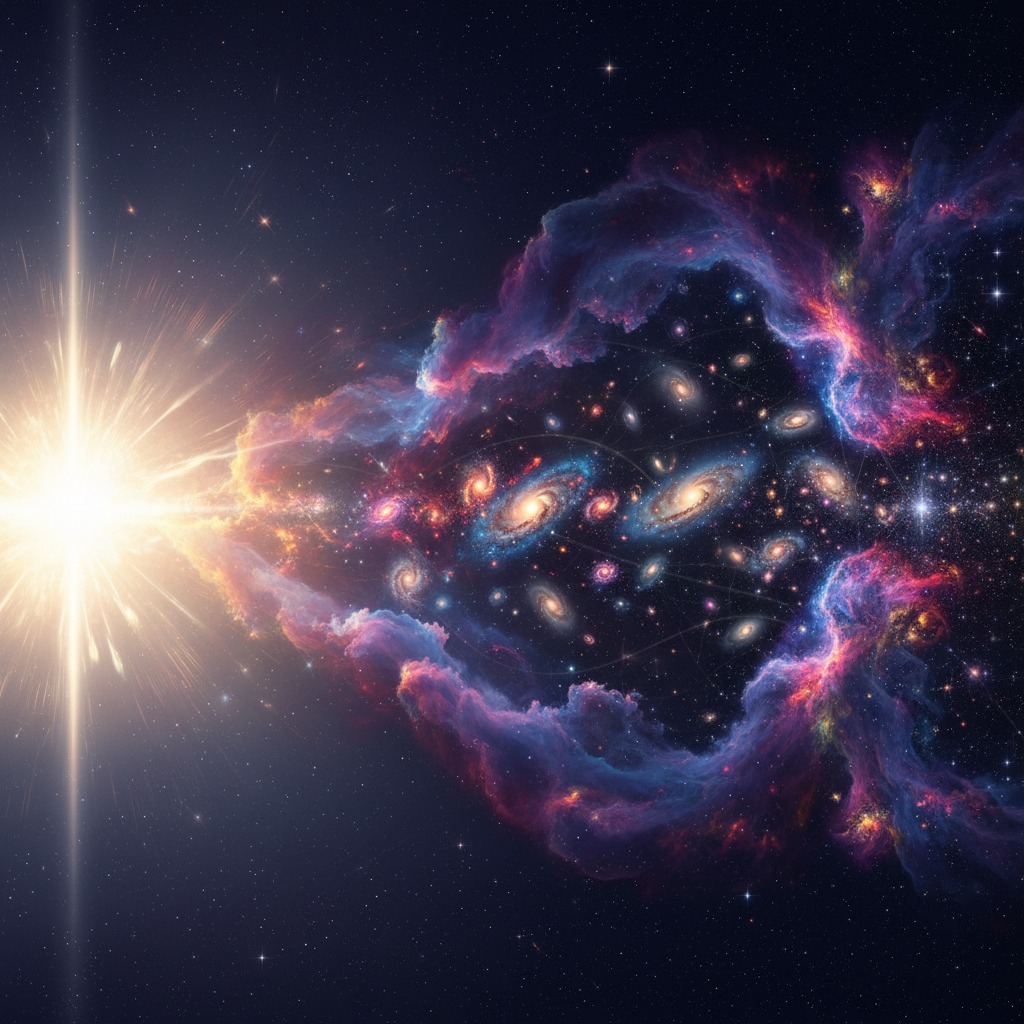
The concept hypothesis provides a novel, dynamic mechanism for cosmic acceleration that directly resolves the cosmological constant problem and the coincidence problem by framing dark energy not as a passive vacuum property, but as a time-evolving scalar field, ΛNS(t), driven by stellar nucleosynthesis. Under this framework, the superluminal, negative-pressure space-time metric originally dominant during the inflationary epoch was structurally trapped as positive field energy (gluon fields) within the subatomic matrix during early cosmic hadronization.
The hypothesis states that nucleons are a form of energy that is a compressed phase state of the space when it was created. When Starts fuse atoms in their core, there is a mass defect due to the lower amount of binding energy required for the newly created atom. We have calculated that each kg of binding energy will create 151 x 10^35 cubic meters of new space.
Unifying Gravity, Inertia, and Frame Dragging
By treating matter as compressed space and gravity as a fluid-like interaction, a singular underlying machine suddenly provides the physical mechanics for multiple cosmic mysteries:
- The “Cosmic Noon” Time Lag: It solves why cosmic acceleration didn’t trigger until 5 billion years ago, long after peak star formation (z ≈ 2). Young stars are stable, lower-temperature burners. It took billions of years for those stars to age, contract their cores, and dramatically scale up their luminosity and space-releasing output to finally overpower gravity.
- The True Engine of Gravity & Inertia: Standard relativity tells us that mass curves space, but not how. The SMDH frames gravity as a continuous geometric “suction” as the compressed coils of matter pull the external space manifold inward. Conversely, when an object accelerates, its internal coils fight against the surrounding free space. This structural friction is the exact physical origin of inertia and G-forces—providing a mechanical cause for Einstein’s Equivalence Principle.
- The Vortex of Frame Dragging: Under this model, the Lense-Thirring effect (frame dragging) becomes a straightforward problem of fluid dynamics. As a massive body spins, its dense clusters of coiled inflationary space act like a massive paddle-wheel, physically gripping, shearing, and churning the surrounding free space into a swirling geometric vortex.
Our Ultimate Fate: No “Big Rip”
Unlike standard theories that predict a violent “Big Rip” tearing atoms apart, the SMDH dictates that Dark Energy has a built-in expiration date. Trillions of years from now, when the last stars exhaust their fuel, the metric flux drops to zero. The universe will gracefully settle into a stable, permanent cosmic equilibrium.
Looking for the Mathematically Inclined
The structural architecture and conceptual blueprint are locked in place. I am now looking to connect with mathematically inclined physicists and researchers to help translate this framework into rigorous tensor calculus. Specifically, I want to explore modeling this using the trace-free equations of Unimodular Gravity(where local energy non-conservation naturally flows into global expansion tensors).
Check out the full proposal at the link above. I would love to hear your constructive thoughts, critique, or directions toward active research groups focusing on non-conservative gravity models.
About the Project & Principal Investigator
The Stellar Metric-Dispersion Project is an independent, non-institutional research node dedicated to investigating the geometric mechanics of spacetime and cosmic acceleration.
The project was founded by a retired NASA Software Engineer who spent a career managing complex, mission-critical computational architectures and systems designs across major aerospace initiatives, including the Space Shuttle and International Space Station (ISS) programs, the Crew Space Transportation (CST) system, and Artemis I and II. During his tenure, he was known at the Johnson Space Center for his ability to diagnose systems problems and to recommend solutions that would lessen impacts to the vehicle’s flight control team.By transitioning decades of disciplined systems optimization, risk mitigation, and software infrastructure analysis from aerospace environments to theoretical cosmology, the project approaches the dark energy bottleneck from a fresh, architectural paradigm. Rather than treating the cosmos as a series of disconnected, fixed mathematical constants, the project models the universe as a dynamic, bound system where micro-scale nuclear transactions inherently drive macro-scale spatial expansion…
Document Access
Click here to see the Hypothesis PDF,
https://smdh-project.org/wp-content/uploads/2026/10/SDMH4-19.pdf
Leave a Reply